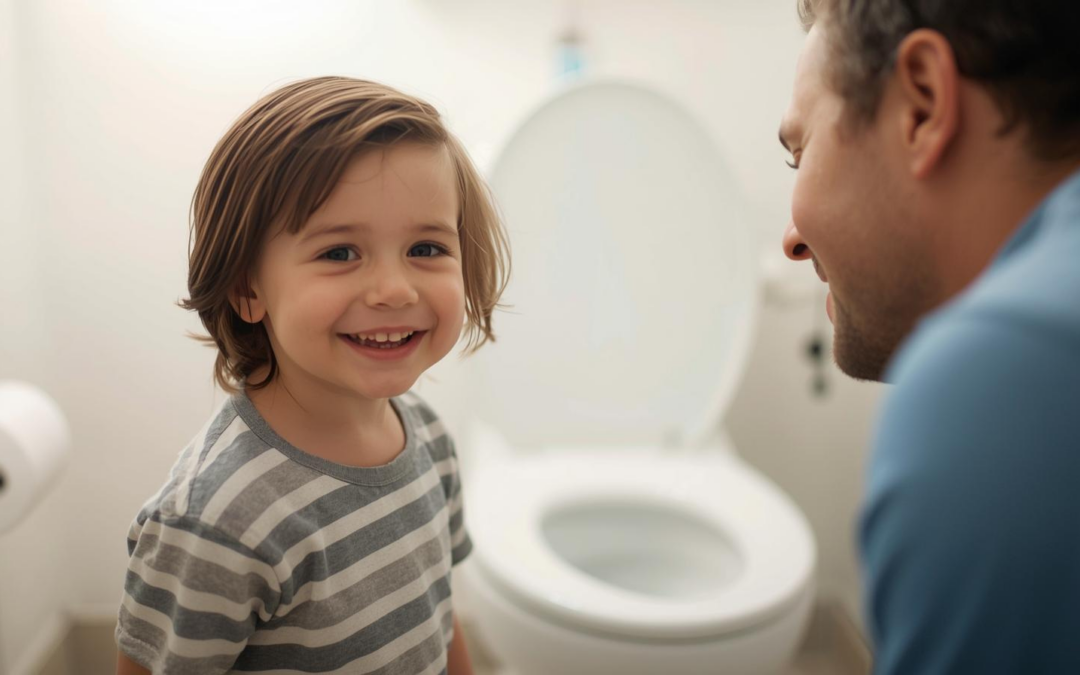
Your child stiffens. They hide behind the couch. They cross their legs, clench their body, or suddenly insist they “don’t have to go.”
And you feel that familiar knot in your stomach — the mix of worry, frustration, exhaustion, and fear — because once again, pooping has become a battle.
If this is your family’s reality, you are not alone. And more importantly: you are not doing anything wrong.
Poop anxiety and stool withholding are far more common — and far more complex — than most parents are ever told. Yet families are often left navigating this painful, emotional struggle with little guidance beyond “add more fiber,” “try rewards,” or “they’ll grow out of it.”
For many children, they don’t. And for many parents, the silence around this issue makes it even harder.
This is exactly why From Fear to Flush: Helping Your Child Overcome Poop Anxiety, Withholding, and Bathroom Fear needed to exist.
Poop Anxiety Is Not a Behavior Problem — It’s a Safety Problem
One of the most damaging myths surrounding stool withholding is the idea that children are being stubborn, manipulative, or defiant.
They are not.
In my work as a pediatric occupational therapist with over 20 years of experience, I have supported hundreds of families dealing with poop anxiety, toileting refusal, and chronic stool withholding. And as a parent who walked this journey with my own child, I can say this with certainty:
Children who withhold are not choosing control — they are seeking safety.
Often, poop anxiety begins with a single painful bowel movement. That experience becomes encoded in the nervous system as a threat. The next time the urge appears, the body remembers: this hurts, this is scary, this isn’t safe.
So the body does what it’s designed to do — it protects itself.
Clenching. Holding. Avoiding.
Over time, this creates a painful cycle: pain → fear → withholding → harder stool → more pain → more fear
No sticker chart can override a nervous system in survival mode.
Why Families Feel So Overwhelmed and Alone
Parents navigating stool withholding often tell me the same things:
“No one warned us this could happen.”
“I feel like I’m failing my child.”
“We’ve tried everything and nothing works.”
“Why does this feel so hard?”
The truth is, most families are trying to solve a body-based, sensory, and emotional issue using tools designed for motivation and behavior. That mismatch creates frustration on both sides.
Children feel pressured. Parents feel helpless. And the relationship around toileting becomes tense.
What families truly need is clear, compassionate guidance that explains why this is happening — and how to support the child without making the fear worse.
The Missing Piece: Understanding the Whole Child
Pooping is not a simple act for a child.
It requires:
Trust in internal body signals (interoception)
Ability to relax the pelvic floor
Sensory tolerance of pressure, movement, and release
Emotional safety
Physical stability and posture
Predictable routines
Soft, comfortable stool
When any one of these pieces is off, pooping can feel overwhelming.
Yet most resources focus narrowly on the toilet itself — not the whole child.
That’s where families get stuck.
They don’t need more pressure. They need a roadmap.
Why From Fear to Flush Is Different
I wrote From Fear to Flush to bridge the gap between professional knowledge and real-life parenting — because families deserve guidance that understands both.
This book combines:
Pediatric occupational therapy expertise
Nervous-system-informed strategies
Sensory-based tools
Developmentally appropriate routines
And the lived reality of parenting a child with poop anxiety
It is not about forcing poop into the toilet.
It is about rebuilding trust — in the body, in the process, and in the parent-child relationship.
Inside the book, families learn:
Why children withhold (and why it’s not misbehavior)
How fear and pain become wired in the body
How sensory sensitivities impact toileting
How posture and physical support change everything
How to create calm, predictable routines
How to support hydration, fiber, and movement without power struggles
How to handle setbacks without shame
What real progress actually looks like
Most importantly, parents learn how to stop fighting their child — and start supporting them.
Frequently Asked Questions About Poop Anxiety and Stool Withholding
What is poop anxiety in children?
Poop anxiety is a fear-based response to bowel movements, often rooted in a past painful or frightening experience. Children may withhold stool, avoid the toilet, or become highly distressed when they feel the urge to poop. This is not a behavioral issue — it is the body’s attempt to stay safe.
Why does my child refuse to poop even when they need to go?
Many children withhold stool because their nervous system associates pooping with pain or danger. Even when the body signals that it’s time, fear overrides the urge. This can lead to a cycle of withholding, harder stools, and increased anxiety.
Is stool withholding the same as encopresis?
Stool withholding and encopresis are closely related but not the same. Withholding refers to intentionally holding stool due to fear or discomfort. Encopresis occurs when retained stool leads to leakage or accidents. Addressing withholding is a critical step in resolving encopresis.
Will my child grow out of poop anxiety?
Some children improve with time, but many do not — especially if the pain-fear cycle is not addressed. Without support, stool withholding can persist and become more entrenched. Gentle, informed intervention helps children feel safe again and supports long-term success.
What should I avoid doing if my child is afraid to poop?
Pressure, punishment, rewards tied to pooping, and frequent reminders can unintentionally increase fear. These strategies focus on behavior rather than the underlying nervous system response. A calm, supportive approach that prioritizes safety and regulation is far more effective.
How can occupational therapy help with poop anxiety?
Pediatric occupational therapy supports the sensory, emotional, and physical components of toileting. This includes body awareness, posture, regulation, routine-building, and reducing fear responses — all essential pieces for children struggling with poop anxiety and stool withholding.
Extra Support Beyond the Book
In addition to the paperback, From Fear to Flush can also be downloaded digitally with additional tools aligned with the book, including practical resources families can use right away to support routines, body awareness, and consistency.
These extra tools are designed to make implementation easier — especially for parents who feel overwhelmed and don’t know where to start.
Because families don’t just need information. They need support they can actually use.
You Are Not Behind — You Are Right on Time
If you’re reading this and recognizing your child, your home, your stress — take a breath.
You are not failing. Your child is not broken. And this struggle does not define either of you.
Poop anxiety is a nervous system story. And nervous systems can learn safety again.
With patience, understanding, and the right support, progress does happen — quietly, gently, and often sooner than you expect.
Learn More About From Fear to Flush
If your family is struggling with poop anxiety, stool withholding, toileting refusal, or bathroom fear, you can learn more about the book here:
👉 From Fear to Flush: Helping Your Child Overcome Poop Anxiety, Withholding, and Bathroom Fear 🔗 https://amzn.to/4q3pDyS
Available in paperback and digital formats, with optional downloadable tools aligned with the book.
You and your child are on the same team. And there is a calm, supportive path forward — one step at a time.
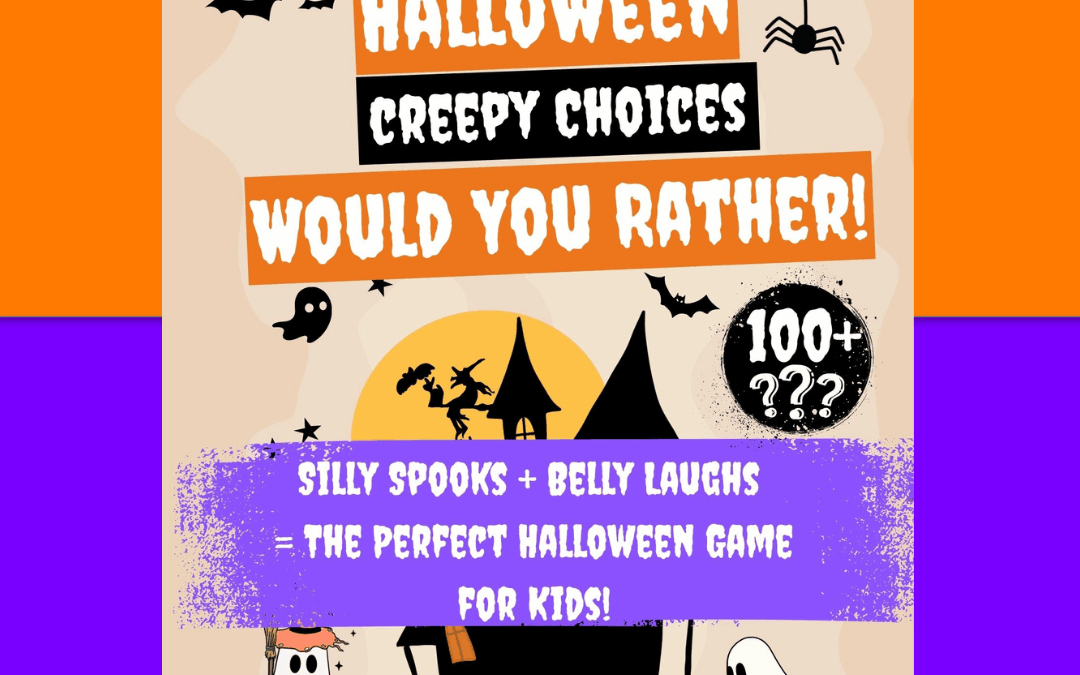
Ready to bring on the giggles, gross-outs, and belly laughs this Halloween? Our Halloween Would You Rather Game is the must-have printable that will make your classroom, party, or family night boo-tifully fun! 👻
Kids can’t get enough of silly, spooky “Would You Rather” questions — and this game packs over 100 hilarious choices that spark laughter and imagination.
Watch the giggles roll in when they have to decide:
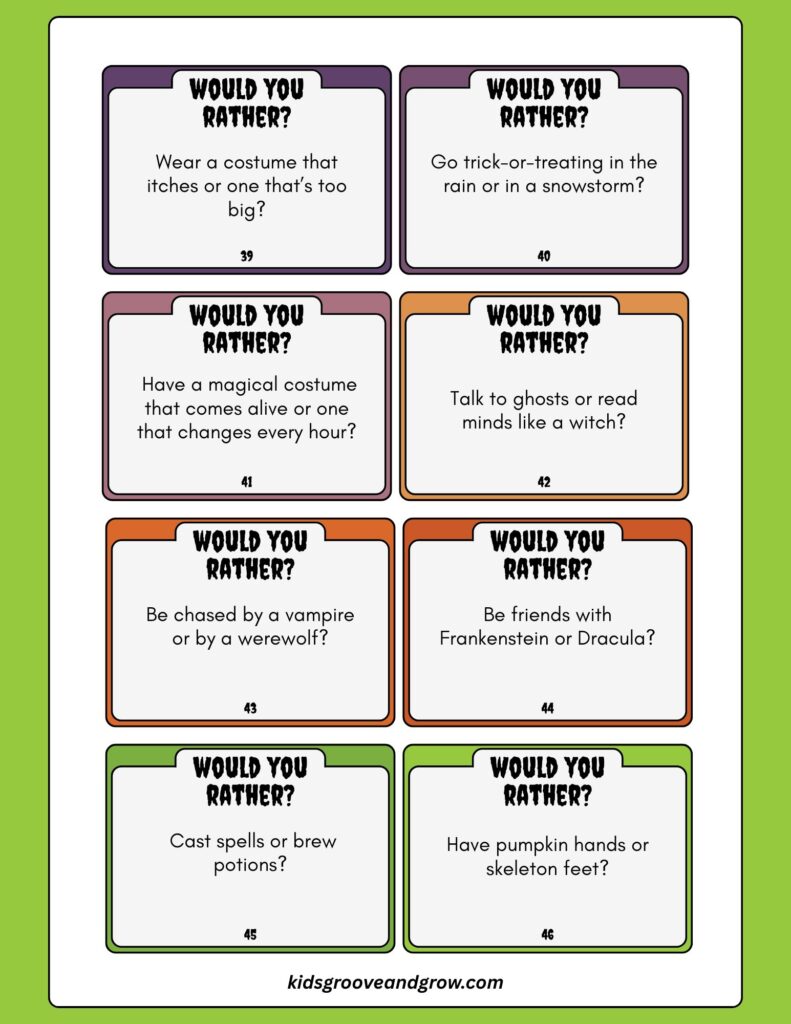
“Would you rather eat chocolate eyeballs or gummy worms?” “Would you rather dance with skeletons or sing with ghosts?”
The laughter never stops! It’s an easy, no-prep way to bring everyone together — at school, at home, or at your Halloween party.
Bring Halloween laughter to your classroom or home with these printable Would You Rather cards featuring spooky, silly, and kid-friendly choices.
🧡 A Perfect Brain Break for Classrooms
Teachers love it as a quick Halloween brain break or a fun Friday treat. Just print, cut, and play — no prep, no mess! It keeps students focused, engaged, and practicing social skills like turn-taking, communication, and creativity.
Even shy kids light up when it’s their turn to choose between spooky (or totally silly) scenarios. The classroom fills with laughter and connection — and that’s when learning magic happens! 🎃✨
🧠 Why Kids Need Laughter & Brain Breaks
As a pediatric occupational therapist, I see firsthand how movement, laughter, and imagination help children regulate their energy, improve focus, and reset their brains.
Quick, playful games like Would You Rather give kids a moment to relax and recharge — especially during busy school days filled with structure and expectations.
When kids laugh, their bodies release feel-good chemicals that boost mood and lower stress. Brain breaks like this don’t just create fun — they actually support: ✔ Self-regulation and attention ✔ Flexible thinking ✔ Language and social development ✔ Group participation and teamwork
So when you play this game, you’re not just having fun — you’re building skills that matter! 💛
🕸️ Family & Party Fun That Everyone Loves
This printable game is a hit for Halloween parties, trick-or-treat gatherings, and family game nights. Kids, parents, and even grandparents will laugh their way through every round.
It’s perfect before candy time, during dessert, or when everyone needs a quick laugh break. You’ll love seeing everyone — from toddlers to teens — crack up at the spooky and silly choices! 👻
Family time can get busy, but this easy printable helps you slow down, share laughs, and make lasting memories.
🧙 Easy to Use — Print, Cut & Let the Fun Begin!
No complicated setup here — just download, print, cut out the cards, and let the fun begin.
Use it in: • Classrooms and learning centers • Family game nights • Halloween parties • Youth groups or after-school programs
Once printed, you can laminate the cards to use year after year — it’s a Halloween tradition in the making! 🕷️
🎃 Why Kids (and Adults) Love It
✔ Encourages laughter and creativity ✔ Builds language and social skills ✔ Easy brain break for classrooms ✔ Instant printable fun for parties or home ✔ Designed by a pediatric occupational therapist for purposeful play
🍂 Tips for Using This Game
Want to make the most of your Halloween Would You Rather Game? Here are a few simple ideas:
In the Classroom:
Use it as a quick five-minute transition or morning meeting activity.
Pair it with a writing prompt — “Which choice would you pick and why?”
Let kids take turns reading the questions aloud to build confidence and fluency.
At Home:
Turn it into a dinner-table tradition in October — pull one card each night!
Keep the deck handy for car rides or bedtime giggles.
Use it for family game night — winner gets an extra piece of pie! 🥧
At Parties:
Make a “Would You Rather Corner” and let guests grab a question card from a pumpkin bowl.
Create team rounds where kids try to guess what others will choose.
Add a timer and play “rapid-fire” for extra laughs.
It’s simple, silly, and guarantees fun no matter where you use it! 🍭
👻 Don’t Miss Out on the Fun!
This Halloween, skip the boring games and bring home the laugh-out-loud favorite that every kid will be talking about.
Check out more play-based, fine-motor, and seasonal printables at Kids Groove and Grow — where learning and laughter always go hand in hand! 🌟
🌟 Thank You for Reading!
Thank you so much for stopping by Kids Groove and Grow! If this Halloween Would You Rather Game made you smile, please share it with a friend, teacher, or parent who would love a little extra laughter this season.
Because when kids giggle, learn, and grow through play — everyone wins! 🎃💛
🍁 Keep Reading for More Fall Fun!
If you’re looking for more playful ideas this season, check out our other fall posts!
Halloween excitement brings the perfect opportunity to blend fun with skill-building, especially when it comes to developing fine motor strength in young children. One of my favorite tools as a pediatric occupational therapist has always been Q-tip painting. It’s simple, low-cost, calming, and incredibly effective for strengthening grasp and improving precision — two foundational skills children need for writing, dressing, cutting, and more.
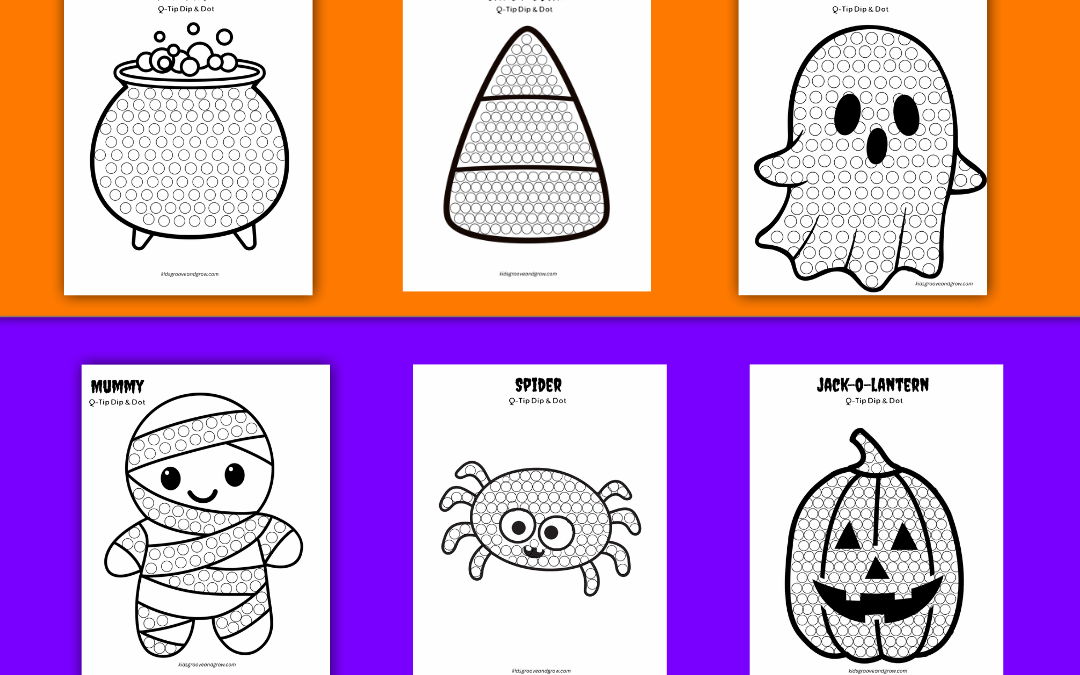
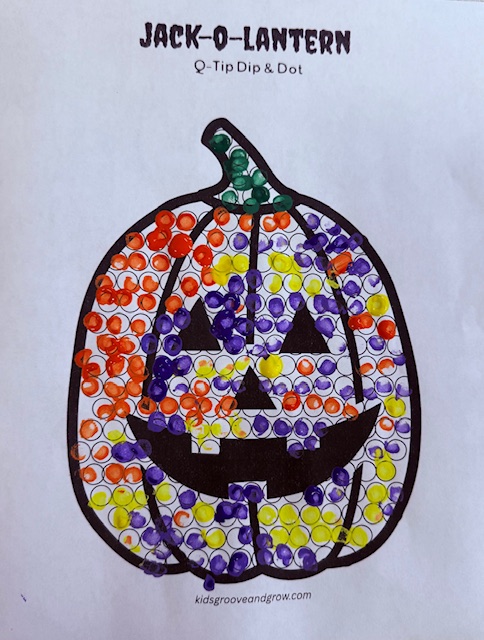
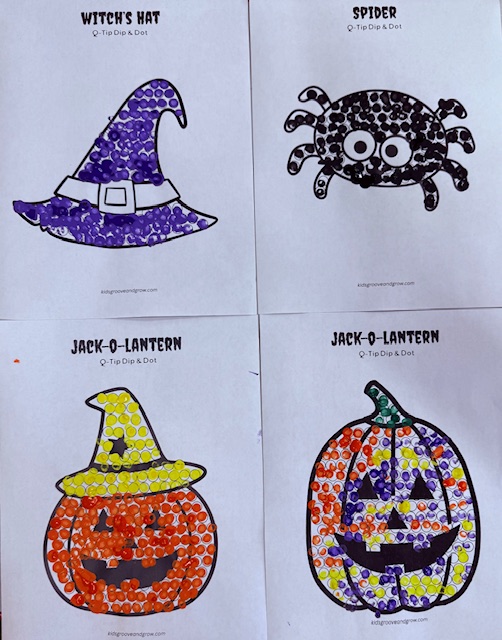
That’s why I created a set of Halloween Q-Tip Painting pages designed specifically to promote strong finger control in a playful way. With ten themed worksheets featuring pumpkins, ghosts, bats, candy corn, and other fall favorites, children stay engaged without realizing how much their hands are actually working.
Why Q-Tip Painting Supports Grasp and Precision
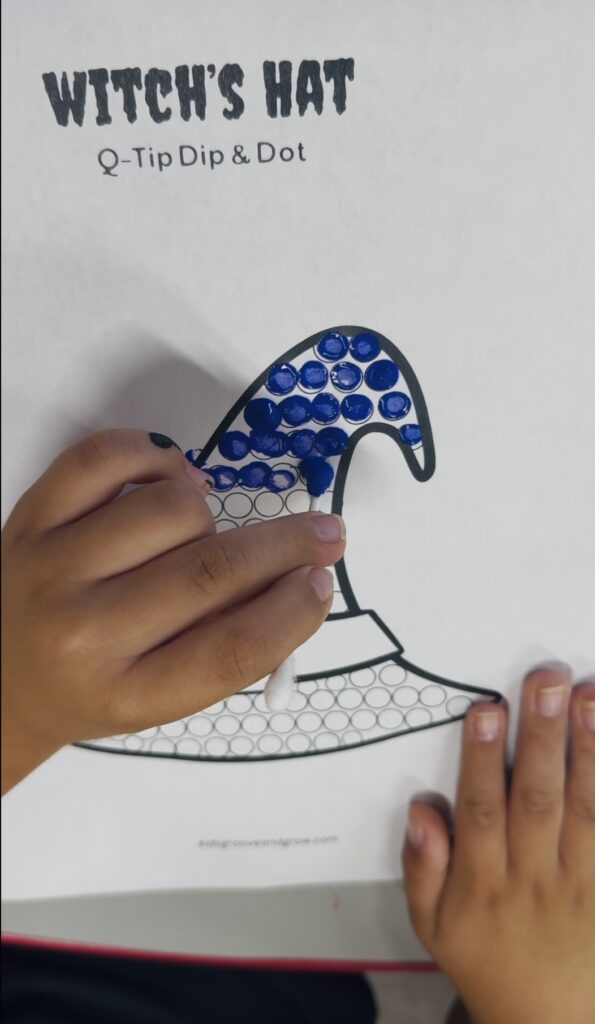
A Q-tip naturally encourages a refined finger grasp. Unlike broad markers or chunky paintbrushes, the slim cotton swab fits best between the fingertips, guiding children toward proper finger positioning without needing correction. As they dip the Q-tip into paint and gently dab each dot, they practice intentional movements rather than fast scribbling.
Each dot becomes a small target, encouraging careful placement and controlled pressure. This strengthens the muscles of the hand and fingers while improving hand-eye coordination. Over time, this kind of precise repetition prepares children for writing letters, using scissors, fastening buttons, and more complex classroom tasks.
Painting the Witch’s Hat with Q-Tip Magic
What’s Included in the Halloween Q-Tip Pack
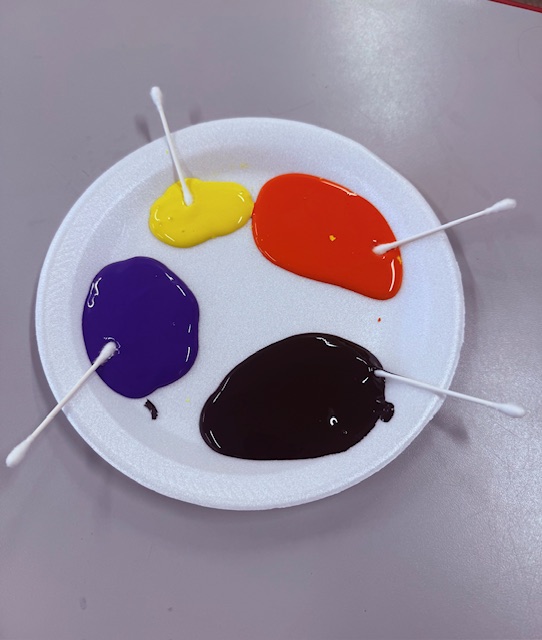
The printable set includes ten high-contrast black-and-white pages designed for home, classroom, or therapy use. Each page features a themed design surrounded by dot markers that cue where to dip and dab. The pages print clearly on standard paper and work well with washable paint, short crayons, cotton balls clipped with clothespins, pom-poms, or even stickers if you prefer a paint-free option.
The goal is not perfection — it’s steady movement, finger control, and completing one dot at a time with focus.
Easy Ways to Use These in Different Settings
These pages work beautifully in preschool and kindergarten centers, morning work tubs, fine motor stations, and small group tables. In therapy sessions, they can be used as warmups before handwriting or cutting activities. At home, they offer a calming alternative to screens and can easily be paired with a fall storybook or quiet time corner.
If you’d like to build a full fine motor circuit for fall, combine these with myPumpkin Tracing and Coloring Worksheets for pre-writing control andPumpkin Cutting Skills Practice Sheets for bilateral coordination and scissor accuracy. Switching between tracing, cutting, and dab painting targets multiple hand functions in one session while keeping the theme consistent and fun.
Fine Motor Benefits You Can Expect
With regular use of Halloween Q-Tip Painting pages, you’ll start to notice improvements in:
✅ Finger strength and muscle endurance ✅ Pencil grasp development ✅ Hand-eye coordination ✅ Visual scanning and left-to-right tracking ✅ Motor planning and accuracy ✅ Attention and follow-through
The best part is that children often ask to repeat the pages — not because they feel like work, but because dipping and dotting is naturally satisfying.
Kid-approved Halloween Q-tip painting for grip strength and hand precision!
Why Seasonal Themes Matter for Skill Growth
From years of experience, I’ve found that children engage more deeply when an activity reflects what’s happening around them. In October, everything is pumpkins, costumes, and candy. When a fine motor task reflects that excitement, participation comes naturally. A plain worksheet might get ignored, but a silly ghost with dot eyes waiting to be filled in? Suddenly it’s irresistible.
That’s why seasonal activities aren’t just cute. They are strategic. They turn practice into play.
Bring Fine Motor Growth into Your Halloween Routine
If you’re looking for a developmentally meaningful activity that builds hand control while keeping the Halloween mood alive, these Q-tip painting pages are an easy and effective choice. They require almost no setup, support a wide range of skill levels, and deliver real progress one dot at a time.
Thank you for supporting my small business and helping children grow through joyful learning.
Keep the Fine Motor Fun Going!
If your little one loved these Halloween Q-tip painting pages, there’s even more to explore! Be sure to visit our digital store for dozens of playful, OT-approved activities that turn learning into pure joy. From holiday fine motor packs to year-round preschool printables, you’ll find tools that engage young hands and build real skills without the struggle.
And if you’re diving into all things pumpkin season, don’t miss these reader favorites:
Gross motor skills are the foundation of your child’s development—from their first roll as a baby to hopping, climbing, and skipping as a kindergartener. These big movement skills build strength, balance, and coordination, and they lay the groundwork for fine motor skills, learning, and confidence in school and life.
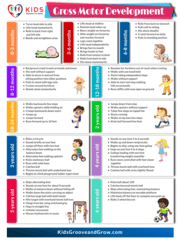
As a pediatric occupational therapist with over 20 years of experience, I’ve seen firsthand how crucial gross motor development is for children’s success. That’s why I created a Gross Motor Skills Chart (birth to 6 years)—a simple, research-backed tool to help parents, teachers, and therapists track milestones and support growth at every stage.
Gross motor skills involve the large muscles of the body—the core, arms, and legs. These abilities allow children to:
Crawl, walk, and climb
Jump, hop, and balance
Ride tricycles or bikes
Play sports and join group activities
When children master these milestones, they gain not only physical ability but also independence, social confidence, and readiness for school. Strong gross motor foundations support fine motor skills (like handwriting and dressing), cognitive growth, and emotional regulation.
📊 Gross Motor Milestones by Age
Here are highlights from my Gross Motor Skills Chart (0–72 months):
0–6 months: Lifts head, rolls over, sits with support
6–12 months: Crawls, pulls to stand, cruises along furniture
Every child develops at their own pace, but talk to a pediatrician or occupational therapist if your child:
Isn’t walking by 18 months
Struggles with balance or frequent falls
Avoids gross motor play or tires easily
Early support makes a big difference!
📥 Download Your Gross Motor Skills Chart Today
With my OT-designed Gross Motor Skills Chart (0–6 years), you’ll have a trusted, easy-to-use tool to track milestones, celebrate growth, and build confidence for the future.
Your dedication to supporting children’s development truly matters. If you’d like to continue learning and building your toolkit, here are more OT-approved articles to explore:
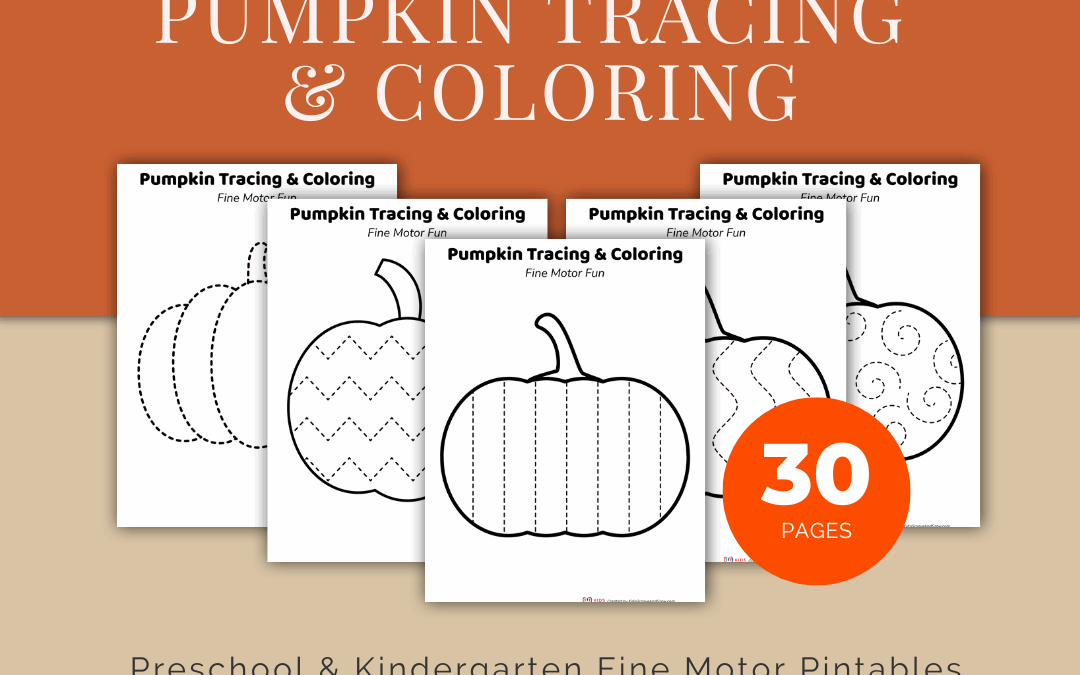
Pumpkin Tracing & Coloring Worksheets are one of the easiest and most engaging ways to help preschoolers build fine motor strength, pencil control, and prewriting readiness—all while enjoying fun fall-themed activities. Kids are naturally drawn to seasonal printables, and when tracing and coloring feel like play (not work), they’re more willing to participate and make progress.
That’s exactly why I created the Pumpkin Tracing & Coloring Worksheets – Fall Preschool Printables — a no-prep resource designed to strengthen essential skills while keeping little learners focused and motivated.
🍂 Tracing Builds Critical Fine Motor and Prewriting Skills
Tracing isn’t just a fun activity — it’s a powerful way to build the foundational skills kids need for writing, coloring, cutting, dressing, and everyday independence. Before young children can write letters or numbers, they must learn how to control a pencil, follow a line, and coordinate both hands together. Tracing helps develop those abilities in a playful, low-pressure way.
Here are key benefits of tracing for preschoolers:
✅ Strengthens fine motor muscles in the hands, fingers, and wrist ✅ Improves pencil grasp for writing, drawing, and coloring ✅ Develops bilateral coordination, using both hands together (one holds the paper, one traces) ✅ Supports hand–eye coordination by guiding controlled movements ✅ Builds visual-motor integration, helping kids connect what they see to how they move ✅ Prepares children for writing strokes like lines, curves, diagonals, and shapes ✅ Improves focus, attention, and perseverance ✅ Supports finger dexterity and control needed for coloring inside shapes
Children who struggle with handwriting, grip strength, or pencil precision benefit greatly from tracing activities that start simple and build gradually. The Pumpkin Tracing & Coloring Worksheets do exactly that — offering the right mix of support, repetition, and fun.
🎃 Pumpkin Tracing Worksheets with Built-In Progression
The Pumpkin Tracing & Coloring Worksheets are developmentally scaffolded so kids can grow their skills at their own pace. This set includes:
✅ Straight-line tracing for control and confidence ✅ Curved lines and wave patterns for visual tracking ✅ Zigzags and angled lines for prewriting prep ✅ Simple pumpkin shapes to trace and color ✅ Coloring components to build finger strength and precision
This makes the resource perfect for preschool classrooms, pre-K, occupational therapy sessions, homeschool, and fall learning centers.
🍁 Great for OT, Classrooms, Homeschool, and Fall Centers
These pumpkin fine motor worksheets are ideal for:
✔ Preschool and pre-K classrooms ✔ Occupational therapy sessions ✔ Homeschool learning ✔ Fine motor centers ✔ Morning tubs or quiet work ✔ Small groups or independent practice
The seasonal theme keeps kids engaged, while the structured tracing paths and coloring sections support the hand skills they need for writing.
🎃 Pair with the Pumpkin Fine Motor Bundle
If you want even more fall fine motor practice, you can pair these tracing and coloring pages with the matching scissor skills worksheets as part of the:
It’s a great option for teachers, OTs, and parents who want both tracing and scissor practice in one download.
💡 Since cutting skills go hand-in-hand with tracing, don’t miss my full blog post on Pumpkin Scissor Skills— packed with strategies and printable resources to build scissor confidence!
✏️ Want More Support with Fine Motor and Prewriting Skills?
These related blog posts are helpful reads for parents, teachers, and therapists:
If you found this post helpful, please share it with a friend, teacher, or parent who would love these fall fine motor activities too. Your support helps more children build confidence through play!
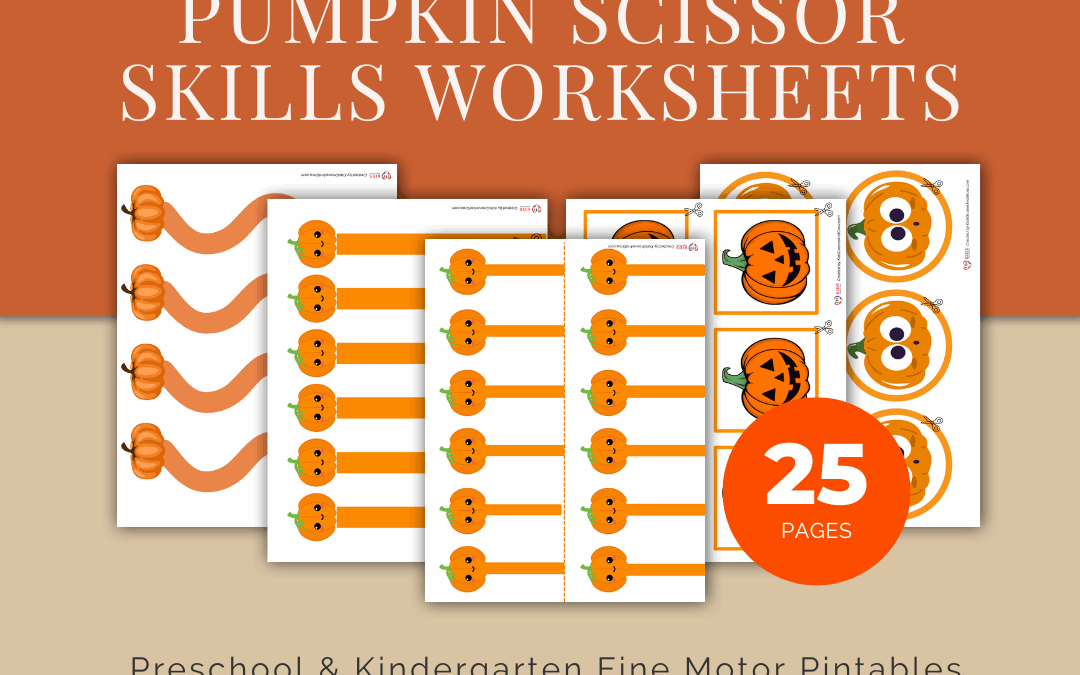
Pumpkin Scissors Skills Worksheets are one of the most effective and engaging ways to help preschoolers build cutting confidence, fine motor strength, and hand coordination in a fun fall-themed way. Kids are naturally drawn to seasonal activities, and when cutting practice feels like play—not work—they’re far more willing to participate and make progress.
That’s exactly why I created the Pumpkin Scissors Skills Worksheets – Preschool Cutting Practice — a no-prep printable designed to support developmental milestones while keeping little learners interested and motivated.
🍂 Scissor Skills Are an Essential Developmental Milestone
Scissor use isn’t just a craft activity — it’s an important preschool milestone that supports: ✅ Fine motor strength ✅ Hand–eye coordination ✅ Bilateral coordination ✅ Pencil grasp development ✅ School readiness
Children who struggle with cutting benefit from visuals, structure, and gradual challenges rather than being given scissors with no guidance. These worksheets provide that support in a developmentally appropriate way.
🎃 Pumpkin Scissor Skills Progression: From Beginners to Advanced Cutters
One of the best things about the Pumpkin Scissors Skills Worksheets is the built-in progression. Whether a child is just starting to snip or needs more advanced cutting practice, each page offers the right amount of challenge.
This set includes:
✅ Beginner snipping pages with thick, bold lines ✅ Straight-line cutting for control and accuracy ✅ Curved and wavy paths for next-level practice ✅ Zigzags and angled lines for building precision ✅ Simple pumpkin shapes for more advanced scissor skills
Perfect for mixed abilities in preschool, pre-K, OT sessions, and at home.
🍁 Great for OT, Classrooms, Homeschool, and Fall Centers
These pumpkin cutting worksheets are ideal for:
✔ Fine motor centers ✔ Occupational therapy sessions ✔ Classroom fall themes ✔ Homeschool lessons ✔ Small groups or independent practice ✔ Quiet work or morning tubs
Because they feature seasonal graphics, kids stay engaged longer and practice cutting without resistance or frustration.
🎃 Pair with Pumpkin Tracing & Prewriting Worksheets
If you also work on pencil control and prewriting skills, the matching pumpkin tracing worksheets make an excellent companion resource. For even more value, both products are included together in the:
✏️ Need Help Teaching Scissor Skills the Right Way?
If you’re looking for pre-cutting activities, a developmental scissor skills checklist, or guidance on how to teach cutting step-by-step, be sure to check out our Scissor Cutting Guide. It’s the perfect companion to the Pumpkin Scissors Skills Worksheets and supports:
✅ Is your child ready to start cutting? ✅ Pre-cutting skills and what comes before scissors ✅ Beginners who are just learning to snip ✅ Kids who need help with hand strength and control ✅ Children practicing diagonal lines, curved lines, and turning the paper while cutting ✅ Children ready to advance to shapes and more intricate cutting forms ✅ Teachers, OTs, and parents who want a clear progression
These posts help you understand when to introduce cutting, how to support different learning levels, and what to do when kids struggle with fine motor tasks.
Thank you for reading! If you found this post helpful, please share it with a friend, teacher, or parent who would love these fall fine motor activities too. Your support helps more children build confidence through play!
Calming spaces for kids are one of the most important things I teach parents and educators about as a pediatric occupational therapist, because children cannot learn, connect, or problem-solve when their nervous system is overwhelmed. When big emotions take over—whether it’s frustration, fear, anger, or sensory overload—the thinking brain goes offline, and the body shifts into a stress response. In these moments, more talking, lecturing, or insisting often does the opposite of what we hope — which is exactly why calming spaces for kids make such a powerful difference.
That’s why creating calming spaces at home and calming corners in schools is not a luxury—it’s a foundational support for emotional development, sensory regulation, and learning.
Why Big Emotions Stop Learning
When children are flooded with big feelings, they shift into a protective state—fight, flight, or freeze. From a neurological lens, that means the prefrontal cortex (the learning and reasoning center) becomes less active, and the lower brain (survival mode) takes over.
Decades of research in education and developmental neuroscience show that stressed children do not process language effectively, retain instructions, or follow multi-step directions. The more we talk in those moments, the more overwhelmed they become.
You might see:
Blank stares
Defiance or aggression
Shutting down
Running away or hiding
Meltdowns
It’s not that they won’t listen — it’s that they can’t.
Regulation Before Expectation
There’s a phrase I use often with families and teachers:
“We must regulate before we can educate.”
Children learn best when their body and brain feel safe, calm, and connected. If their emotional state is dysregulated, we need to address the nervous system first—not the behavior.
Developing emotional regulation is not just a “nice skill.” It directly impacts:
✅ Confidence
✅ Social skills
✅ Attention and focus
✅ Problem-solving
✅ Academic readiness
✅ Emotional resilience
Children who are supported in their regulation early in life tend to be happier, more confident, and stronger learners in the long term.
The Role of Polyvagal Theory
The Polyvagal Theory, developed by Dr. Stephen Porges, helps explain why sensory calming spaces and co-regulation are so effective in addressing emotional regulation. It tells us that the state of the nervous system determines how a child feels, acts, and responds to their environment.
The three primary states:
Safe & Regulated (Ventral Vagal State)
Calm, engaged, curious, connected — ready to learn and interact
Fight or Flight (Sympathetic Arousal)
Tantrums, yelling, running, arguing, hyperactivity — body in defense mode
Shut Down / Freeze (Dorsal Vagal State)
Hiding, silence, collapse, withdrawal — nervous system overwhelmed
When a child is dysregulated, the goal is not to correct behavior—it’s to shift their state back into a safe one. This happens through co-regulation, sensory supports, and visual tools that guide emotional recovery.
Why Visuals Work Better Than Words During Dysregulation
When kids are overwhelmed, they process visuals far more effectively than words. That’s why emotional cue cards, breathing visuals, and simple images are so much more powerful than phrases like:
❌ “Calm down.”
❌ “Use your words.”
❌ “Take a deep breath.”
❌ “You’re fine.”
Visual supports bypass the language-processing barrier and provide a concrete reference point to follow. They also empower independence and consistency across caregivers.
Mentioning visual and sensory supports within calming spaces at home and in the classroom helps both adults and children respond in real-time.
What Is a Calming Space or Calming Corner?
A calming space at home or a calming corner (or calming space) in the classroom is a safe, inviting area where children can:
Feel supported, not punished
Take breaks when overwhelmed
Use sensory and visual tools to recover
Build self-awareness and independence
Practice regulation skills with or without an adult
These emotional regulation spaces support both home environments and school settings.
Creating a Calming Corner (or Calming Space) in the Classroom
In schools, a calming corner (or calming space) can be small and simple while still being effective.
Teachers often report fewer meltdowns, smoother transitions, and greater independence when calming corners are accessible—not just during crises, but also throughout the day.
Creating a Calming Space for Kids at Home
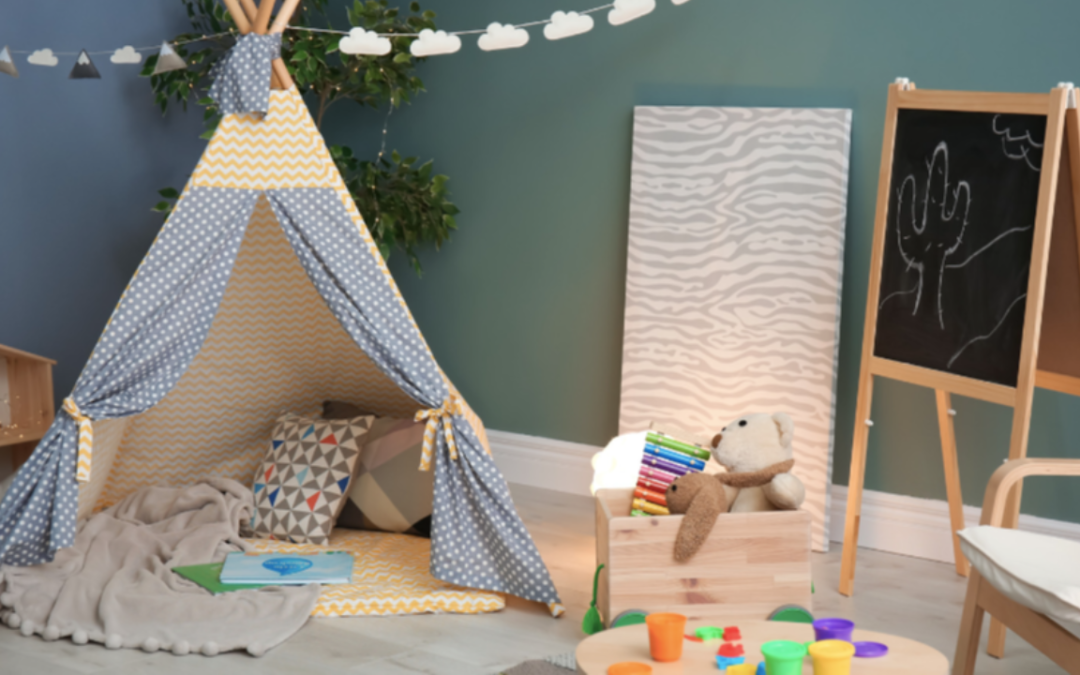
A calming space at home can be simple, flexible, and tailored to your environment. It doesn’t need to be a full corner—it can be:
A floor pillow in a cozy spot
A small tent or pop-up fort
A cushion with a basket of tools
A quiet bedroom or reading nook
Great calming tools for home include:
✅ Cozy blanket or stuffed animal
✅ Breathing visuals
✅ Calming strategy cards
✅ Sensory bottles
✅ Putty or fidget toys
✅ Books about feelings
✅ Noise-canceling headphones
✅ Soft lighting or fairy lights
At home, this space should always feel supportive and optional—not like a time-out or a place of isolation.
Co-Regulation: The First Step in Calming
Young children don’t calm down alone—they calm down with someone. This is known as co-regulation, and it forms the foundation of all self-regulation.
When a child is overwhelmed, their nervous system goes into survival mode. They can’t access logic or language—but they can respond to the presence of a calm, trusted adult.
Co-regulation looks like:
Sitting nearby without pressure
Getting to their eye level
Breathing slowly and visibly
Using a gentle, calm voice
Offering a visual tool
Saying, “I’m here to help your body feel safe.”
A dysregulated child borrows your calm before they can find their own. Over time, children internalize these experiences and transition into self-regulation.
Why Teaching Self-Regulation Early Matters
Research indicates that self-regulation in early childhood predicts long-term academic achievement, confidence, and emotional resilience more effectively than early academic skills.
Programs that include SEL, calming strategies, and calming spaces for kids reduce:
❌ Challenging behavior
❌ Anxiety
❌ Shutdowns or power struggles
❌ Classroom disruptions
They improve:
✅ Attention and learning
✅ Confidence and independence
✅ Social skills and peer interactions
✅ Emotional maturity
When we invest in calming spaces for kids, we invest in lifelong learning.
Tools You Can Use Right Away
Here are powerful tools you can add to calming spaces at home and in the classroom:
Visual Supports
✔ Calming Cards for Kids
✔ Feelings charts
✔ Breathing posters
✔ First–Then boards
Sensory Tools
✔ Fidgets
✔ Putty or playdough
✔ Sensory bottles
✔ Weighted lap pads
✔ Stretchy bands
Comfort Items
✔ Pillows or bean bags
✔ Stuffed animals
✔ Blankets
✔ Cozy lighting
Movement Options
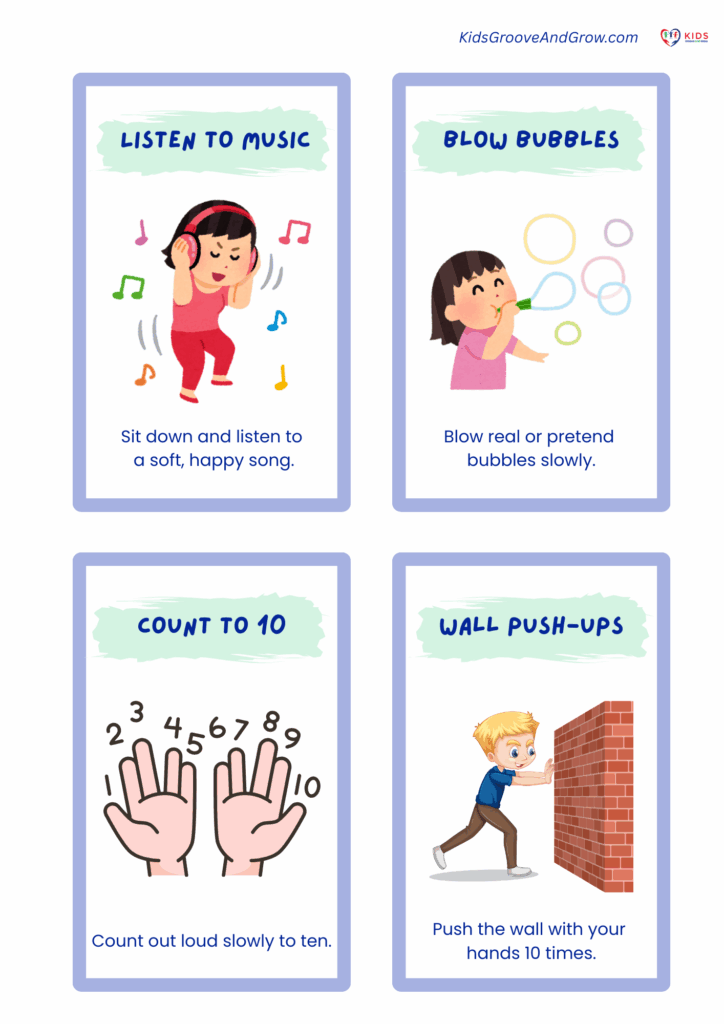
✔ Wall pushes
✔ Animal walks
✔ Rocking chair
✔ Yoga cards
The Big Picture: Regulation Is a Skill, Not a Behavior Problem
Children aren’t born knowing how to manage big feelings — we teach them. And the earlier we start, the more confident, secure, and successful they become.
When we prioritize calming spaces for kids in both home and school settings, we give children the regulation support their brains are wired to need.
Creating calming spaces for kids at home and in the classroom sends a powerful message:
“Your feelings are safe here. You’re not in trouble. I’ll help you learn how to handle them.”
When a child feels safe, connected, and understood, their brain can return to learning, playing, and growing. That’s the foundation of lifelong regulation.
And it starts with something as simple—and powerful—as a calming space.
Explore More Tools That Support Emotional Regulation
Creating calming spaces for kids is powerful—but pairing them with the right tools makes them even more effective. If you’re ready to support emotional regulation in meaningful, practical ways, here are OT-designed resources you can start using right away:
✅ Calming Cards for Kids 40 printable, child-friendly strategies that support self-regulation in real time. Explore them here:Calming Cards for Kids
✅ Animal Walks Movement Cards Perfect for sensory input, calming transitions, and regulation through movement. Explore them here: Animal Walks Movement Cards
These tools help calming spaces feel safe, accessible, and empowering—because emotional safety builds stronger learners, happier homes, and calmer classrooms.
Articles to Read Next
If you’d like more OT-based strategies, here are helpful reads to continue with:
Calming cards can be powerful tools for children learning to manage big emotions. As a pediatric occupational therapist with over 20 years of experience, I’ve seen firsthand how overwhelming big feelings can be for children. Whether it’s a meltdown in the grocery store, refusal to transition at school, or bedtime battles, emotional dysregulation is something all kids experience at some point. But what if we could give them tools to navigate those moments confidently instead of being frustrated?
That’s why I created the 40 Calming Cards for Kids—a simple, evidence-based resource that helps children build emotional regulation skills in a playful, empowering way.
Why Emotional Regulation Matters
Emotional regulation is the ability to manage and respond to emotional experiences in a socially appropriate and flexible way. It develops gradually and is heavily influenced by a child’s environment, sensory processing abilities, and caregivers’ co-regulation.
Without strong self-regulation skills, children may struggle to focus in school, build healthy relationships, fall asleep at night, or recover from stress. Over time, chronic dysregulation can lead to anxiety, oppositional behavior, and low self-esteem.
The good news? Emotional regulation can be taught, and it’s never too early to start.
The Science Behind Calming Strategies: A Polyvagal Perspective
When we talk about regulation, we can’t ignore the nervous system. Dr. Stephen Porges’s polyvagal theory provides a powerful framework for understanding why some children respond to stress with fight, flight, or shut-down behaviors.
According to this theory, the vagus nerve acts as a superhighway of communication between the brain and body. It helps determine whether we feel safe and connected or need to protect ourselves.
Children who have trouble regulating their emotions are often stuck in survival mode, bouncing between high arousal (hyperactivity, meltdowns, aggression) and low arousal (shut-down, withdrawal, fatigue). By activating the ventral vagal system, which is associated with feelings of safety and calm, we can help them return to a regulated state.
This is where calming strategies come in.
Deep breathing, rhythmic movement, heavy work, visualization, and positive self-talk stimulate the vagus nerve and support regulation. When practiced consistently, these strategies strengthen the nervous system’s flexibility and resilience—key components of emotional well-being.
What Are Calming Cards for Kids?
Calming cards are visual and tactile tools that guide children through self-regulation techniques. Each card in the set includes:
A clear, child-friendly calming strategy
A visual cue or playful illustration
Simple language that encourages independence
These cards serve as external organizers, meaning they help children access coping strategies even when their internal system feels chaotic. They’re ideal for use at home, in classrooms, therapy sessions, and even on the go.
Support big feelings with these printable calming cards! 🎨
How Calming Cards Support Development
Visual support: Many children (especially those with sensory processing challenges, ADHD, or autism) benefit from visual reminders. The calming cards offer an accessible, non-verbal prompt to help kids reorient and refocus.
Promotes independence. Instead of relying solely on adults for help, kids begin to recognize what they can do to calm themselves. That’s powerful.
Encourages Practice Regulation takes repetition. Having calming cards nearby increases the chances of practicing strategies regularly, before a meltdown hits.
Co-Regulation Tool Adults can use the cards with children, modeling each strategy and creating moments of connection. This is the heart of co-regulation.
Building a Routine Using calming cards as part of a daily check-in or quiet time can build consistent habits that children carry into adolescence and beyond.
Who Can Benefit From Calming Cards?
These calming cards are ideal for:
Preschoolers and elementary-aged kids
Children with sensory processing challenges
Kids with ADHD or autism
Anxious or highly sensitive children
Any child learning how to name, express, and manage their feelings
They’re also a helpful tool for:
Parents
Teachers
Occupational therapists
School counselors
Child psychologists
Real-Life Ways to Use Calming Cards
Morning routine support – Choose a calming card before school to start the day grounded.
Classroom calm corner – Let students pick a card when they need a break or brain reset.
Bedtime wind-down – Use the cards as part of your nightly routine to soothe the nervous system.
Therapy sessions – Use them to practice sensory strategies or introduce coping skills.
Travel and transitions – Bring the cards in the car or backpack to ease change and unpredictability.
Sample Cards You’ll Find in the Set
Here’s a sneak peek at a few of the strategies you’ll find in the 40 Calming Cards for Kids:
“Smell the flower, blow out the candle” – a simple deep breathing exercise
“Stretch like a cat” – gentle movement to release tension
“Wrap up like a burrito” – proprioceptive input for comfort
“Squeeze and release” – muscle tension and relaxation
“Say something kind to yourself” – building inner dialogue
“Imagine floating on a cloud” – guided visualization
Each strategy is evidence-informed and rooted in sensory integration and self-regulation practices used in pediatric occupational therapy.
Empowering Kids to Calm with Confidence
Children face more stress and sensory overload in today’s fast-paced world than ever. Equipping them with tools to understand and manage their bodies and emotions is not just a therapeutic strategy—it’s a life skill.
Calming cards combine neuroscience, playfulness, and visual support to give children a way to connect to their inner calm, no matter what life throws at them.
Ready to Add Calming Cards to Your Toolkit?
Introducing the 40 Calming Cards for Kids—designed by a pediatric OT to help children thrive. These beautifully illustrated, research-informed cards offer simple, actionable strategies for emotional regulation. Whether you’re a parent, therapist, or educator, this set is your go-to resource for supporting kids through life’s big feelings.
✨ Easy to use ✨ Perfect for home, school, or therapy ✨ Kid-approved and therapist-designed
Empower your child to feel calm, confident, and in control.
Grab your calming cards today and help your child turn overwhelm into peace.
Self-regulation directly impacts children’s success in all areas of development. As an occupational therapist, I often work with children who demonstrate disinterest in academic tasks, struggle with attention and focus, and have difficulty managing the world around them. These children might have intense emotions and undesirable behaviors and are often misunderstood. Conversely, some children might appear withdrawn, quiet, and uninvolved. All these children struggle with self-regulation.
What is Self-Regulation?
We often think of self-regulation as impulse control, emotional control, self-management, or self-efficacy. Self-regulation is coping and managing sensory information, emotions, thoughts, and behaviors to produce acceptable, positive, and socially appropriate responses.
Moreover;
“Self-regulation is learning to regulate one’s own physical, emotional, and cognitive processes in healthy, proactive ways to be successful across several domains of life.” (B. Chapin, Self-Regulation Training, 2021)
Furthermore;
“Self-regulation is the ability to do what needs to be done to be optimal for the given situation. This includes regulating one’s sensory needs, emotions, and impulses to meet the demands of the environment, reach one’s goals, and behave in a socially appropriate way.” (The Zones of Regulation, 2019).
Lastly;
“Self-regualtion refers to healthy, adaptive, and appropriate responses to internal and external events.” (B. Chapin, Self-Regulation Training, 2021
As we dive into the phenomenon of self-regulation, we quickly determine that self-regulation does not only relate to children. All of us are continually regulating ourselves by facing everyday challenges. When we encounter a difficult situation, we become less balanced and learn to control and organize our responses.
Effective Self-Regulation
Children who present good self-regulation are generally happy, calm, and collected. They plan and organize. They pay attention in class and exceed in learning and academic performance. Regulated kids make friends quickly and maintain positive social relationships. They listen, take turns, and share. They adjust appropriately to unexpected situations; they calm down quickly and handle frustration without outbursts. Regulated children have a much larger window of emotional flexibility and self-control. They know “right” from “wrong” and display proper judgment skills.
Dysregulation
Conversely, dysregulated peers struggle with what seems easy and natural to their regulated classmates. They have challenges initiating and completing schoolwork. They might need extended time to complete assignments and often need to remember to do homework; when they complete it, they forget to turn it in. They have difficulty staying focused or sitting still. These kids might be disruptive and impulsive in class; they blur out answers and need help waiting their turn.
Dysregulated kids are easily frustrated; they have difficulty thinking clearly and rationally in challenging situations. These children become overwhelmed by the environment or overreact to minor changes; their window of stress tolerance is small. They lose things, they blame others, and they avoid tasks. They do not adhere to rules, demonstrate maladaptive behaviors, and disturb classroom harmony.
Children who struggle with self-regulation might be impatient, rigid, and argumentative. They might shut down or withdraw. It is difficult for them to act appropriately in social situations; they do not make friends easily, and it might be challenging to maintain friendships when they do.
It takes a tremendous amount of energy to navigate a way through a highly demanding school day. These children often operate from a place of internal chaos, fear, and survival. They might shut down, become distracted, or act aggressively.
“Children will do well if they can. It is our job as responsible adults to help others navigate and remove barriers in their lives.” (Green & Ablon, 2006)
Many Children and Adults Struggle with Self-Regulation
As a pediatric occupational therapist, I work with children with many types of neurodevelopmental disorders (i.e., ADHD, Autism Spectrum Disorders, Cerebral Palsy, and Intellectual and Learning Disabilities). Regardless of their type of disability, many of the children demonstrate challenges in self-regulation.
Furthermore, children with special needs are not the only ones who need to learn self-regulation skills. In fact, through my twenty-plus years of working in schools, there is a tremendous need to teach our children self-regulation skills. Educating children on facing everyday challenges and managing themselves in uncomfortable or threatening situations opens the door to success.
Hopefully, as adults, we have developed a healthy and acceptable way of coping with demanding life expectations and unpredictable, challenging spins. While some manage overwhelming frustrations and pressures better than others, we control our impulses and rely on our internal strategies to help us in difficult situations. Although, there might be times we struggle and regret our actions when we are dysregulated.
Need for Self-Regulation Education
Generally, our society places intense value on teaching children concrete academic skills. We teach children how to write and read. We teach them math and science. Yet, if a child does not behave well, we often provide consequences for misbehaving.
Self-regulation is an essential set of skills for success and happiness. Investing in teaching children self-regulation skills is a fundamental way to promote and influence academic success and reduce problem behaviors in the classroom.
Additionally, many general education teachers lack an understanding of self-regulation and do not have the skills to coach healthy behavioral skills. We cannot assume children have learned how to regulate their behaviors properly.
Often, we spend time and energy in unproductive places. We engage in power struggles, personally perceive students’ negative behaviors, and provide punitive consequences. We react instead of responding. Instead, we must provide safety, connection, support, kindness, and acceptance for the student to cope with the lack of regulatory ability.
Conclusion
Teaching self-regulation is a foundational aspect of child development that might often be overlooked. Self-regulation skills have been shown to improve academic performance, positive social interaction, physical health, and emotional wellness and directly impact a child’s success.
Thus, let’s help children gain control of their lives by offering guidance and support as they learn to manage their emotions and actions. It’s a gradual journey that requires patience and consistency but significantly benefits a child’s development and future success.
How do we help dysregulated children learn and succeed? Stay tuned for part 2 to explore valuable tips and strategies.
✨ Thank you for reading! I’m so glad you stopped by. If you found this article helpful, please share it with a friend, parent, or teacher who might enjoy it too. Your support truly makes a difference! 💛
Please check these out to further enhance your understanding of self-regulation.
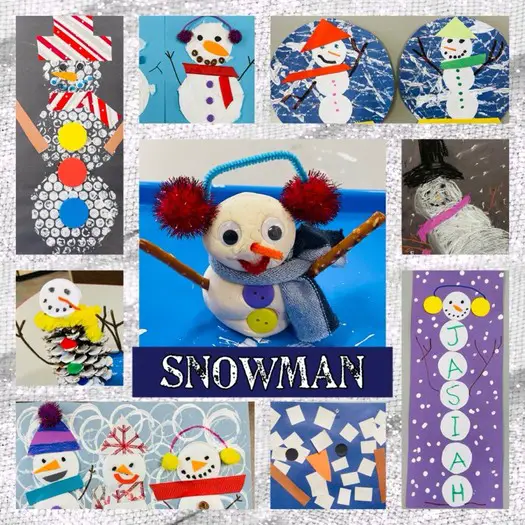
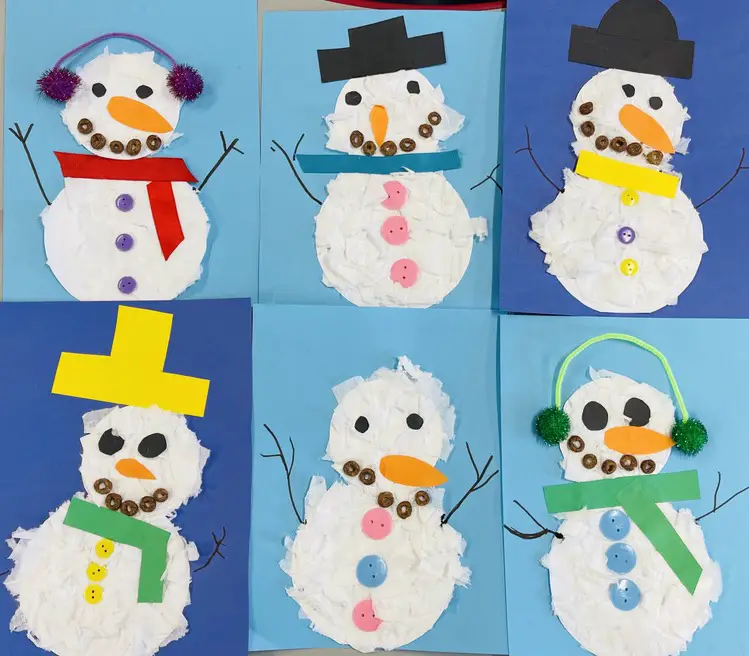
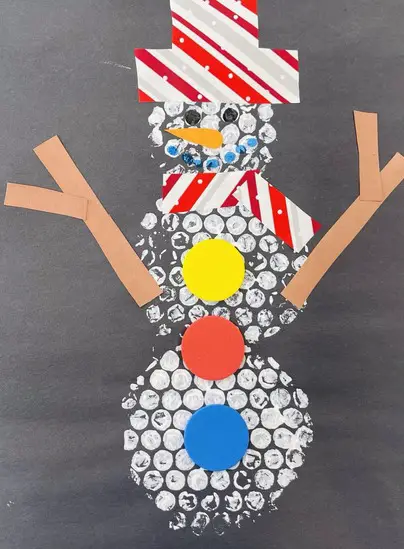
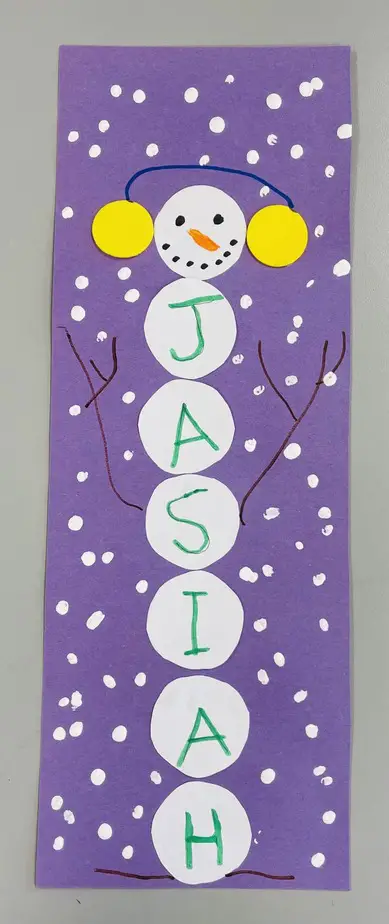
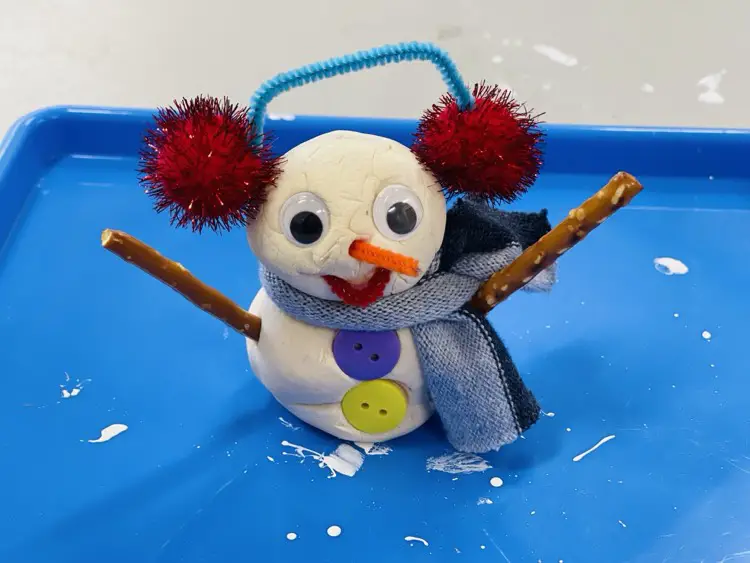
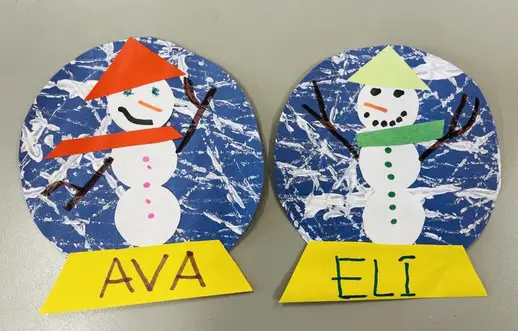
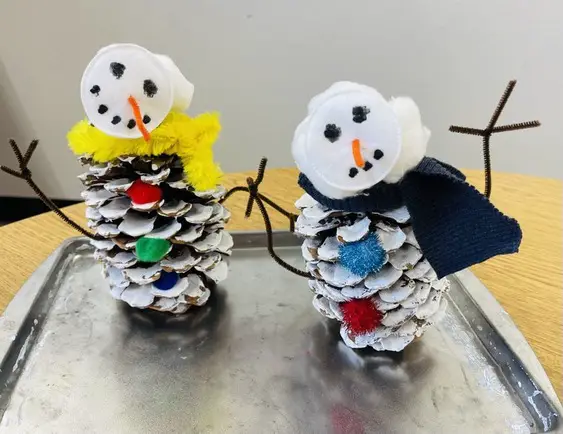
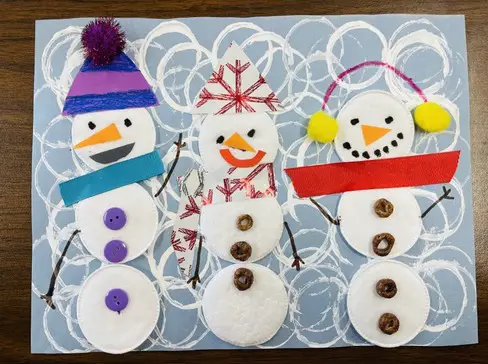
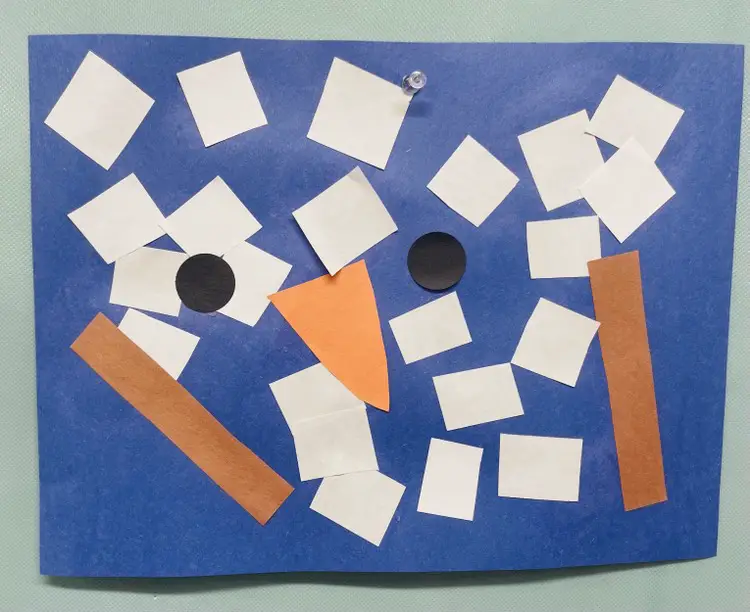
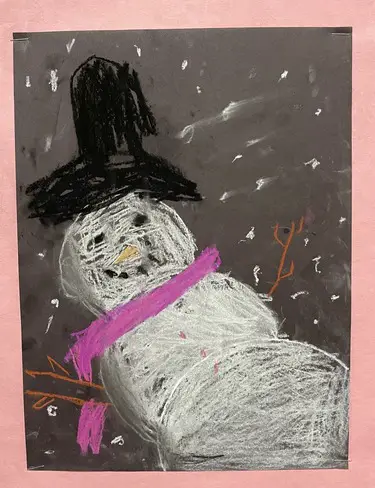
Cute and easy snowman crafts are excellent activities for preschoolers to enjoy during wintertime. These crafts can help preschoolers appreciate the winter season and aid in developing fine motor skills, following directions, and expressing creativity.
Here are some cute and easy snowman craft ideas to try with preschoolers:
Toilet Paper Snowman
Materials:
Paper: a sheet of paper, precut white circles, black small circles, a precut orange nose, and a precut scarf
Precut hat or pompoms for ear muffs (pipe cleaner to connect pompoms or connect pompoms by drawing
decorative art supplies: buttons, ribbons, googly eyes, and markers
Instructions:
Paint the pine cone white with a paintbrush.
Glue and decorate to make a snowman.
Puffy Paint Snowman
Materials:
Shaving cream and glue
Paper
Paintbrush, pencil, markers
Decorative art supplies: buttons, popsicle sticks, ribbons, pompoms, pipe cleaners, cheerios, precut nose/eyes, googly eyes, scrap paper/material (we used old sweaters for scarves and hats).
Draw a snowman with chalk, and provide an example to copy as needed.
Cute snowman crafts add winter spirit around colder months and help us learn about the winter theme. Additionally, snowman crafts help develop fine motor skills, creativity, spatial awareness, and teach children about body parts. Always supervise children with small materials, scissors, and glue. Snowman craft activities are an excellent opportunity for children to learn and have fun. Snow is falling. Let’s make a snowman!
If you enjoyed this post, please share it with a friend!
*Kids Groove and Grow participates in the Amazon Services LLC Associates Program, an affiliate advertising program designated to provide means for sites to earn advertising fees by advertising and linking to Amazon.com.